
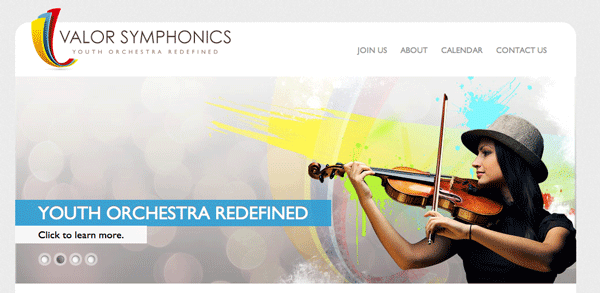
Classical Music As An Immersive Experience

Valor Symphonics wants to break down the invisible wall between the performers and audience, creating an immersive experience that goes beyond passively listening to the music.

Valor Symphonics - RedefinedThere is a new youth orchestra in town. My daughter is a growing young musician, so we checked out an informational meeting. I was blown away by the vision they have for Valor Symphonics here in the South Metro Denver area. Their goal is nothing less than redefining what it means to bring classical music to the community. They want to break down the invisible wall between the performers and audience, creating an immersive experience that goes beyond passively listening to the music. Here’s how they describe some of what they envision.

Classical orchestral music is at the core of what we do, yet we recognize that classical music is struggling to maintain momentum in our culture. We are about regaining that momentum. We plan to passionately and creatively infuse classical music with contemporary sound, story, media, staging and lighting, aspiring to redefine the classical experience in an interactive way people will love!

In my previous life as a media producer in Southern California, I was involved in youth conference events where we tried crazy things to make the event interactive with 10,000 teenagers. That was before computers could do much live, but we were all about making the event a participatory experience with a bit of a story. So I was excited to talk with the folks who are developing Valor Symphonics; they are not just music people, but include dance and film and technology creatives who are all looking at how to reignite the experience of music for concertgoers. I can’t wait to see where this goes (especially, of course, if my daughter gets a chair. Here’s hoping.)

be a learner | theMissonBook.com

Why is this such an innovative concept? Why do we even have to mention this as the preferred approach to cross-cultural ministry?

“Be A Learner”

Why is this such an innovative concept? Why do we even have to mention this as the preferred approach to cross-cultural ministry? Perhaps it’s because we westerners have a low view of other cultures, of alternative learning and communicating styles, of worldviews not formed by the western “Enlightenment?”

Even when I’m teaching something, I always realize my need to learn and understand my students and their context first. I’ve made enough mistakes with my assumptions and biases.

Many times churches ask what they can do on the mission field. How can they help? They often ask this assuming the answer will be that they should come to teach, show, model and develop the people they are trying to help.

  • We come in as teachers.
  • We come in as health care workers.
  • We come as scientists.
  • We come in as business leaders.
  • And to be honest, sometimes we come across as “know-it-alls.”

What if, instead, we came in as learners?

Read Larry McCrary’s full post here: be a learner | theMissonBook.com.

Why Visual Stories Matter

Meet Yuseff and Andrea – two people who represent billions who communicate, learn, and connect in a post-literate world.

Meet Yuseff and Andrea – two people who represent billions who communicate, learn, and connect in a post-literate world.

This is a short film, created for the Visual Story Network, that explains the urgent need for compelling visual stories to communicate the fullness of God’s love for the world. I’m a part of VSN and share this vision.

Ministry of Presence (Nowen) – Urban Entry

More and more, the desire grows in me simply to walk around, greet people…Still, it is not as simple as it seems…

“More and more, the desire grows in me simply to walk around, greet people, enter their homes, sit on their doorsteps, play ball, throw water, and be known as someone who wants to live with them.  It is a privilege to have the time to practice this simple ministry of presence.  Still, it is not as simple as it seems…”

A friend of mine, Scott Lundeen, runs a ministry called Urban Entry here in Denver. He creates media resources to help envision and equip people to engage in relationships and service among the poor and marginalized in our communities. I think they’re doing some cool stuff.

This video was just posted on his blog site. It is based on a quote from Henri Nowen and gets right to the heart of a struggle we often face. Those of us who are acculturated for performance and delivering measurable results as a way of measuring our worth do well to consider Jesus’ call to be in relationship first. It’s what Nowen refers to as a ‘ministry of presence.’ Check it out.

Do you feel the same struggle in your vocation or avocation to make a difference in peoples’ lives? Do you feel envious of programs that get media attention or that are better resourced. Do you feel pressure to ‘achieve’ in a way that ultimately takes you ‘off the streets’?

I sometimes whine about my sad lot – that it’s difficult to see how I can sustain what God has called me to do, that I feel pressure to jump on the social media train that demands I become ‘famous’ in order to become influential and effective. But I feel God’s correction when I really am with the people I want to serve: with my film students, on Skype calls with friends in Africa who teach me as much as I want to teach them, these are the moments of reality and clarity.

My prayer for you is that you have many of those moments, even in the midst of the “necessary” things that shadow the life-giving things.

Creative Constraint – Mashable

…no matter what the resources, budget, etc. we always push ’til there’s nothing left — and then complain about the limitations.

When there are no boundaries, the possibilities may seem too large. That’s why some of the greatest art and innovation has come from a situation of constraint.

My experience has been that, no matter what the resources, budget, etc. we always push ’til there’s nothing left — and then complain about the limitations. And I know I can do this whether I’ve got a million dollars or nothing at all.

Here’s a great article about what I’d call the blessings of constraints. I say that because I know that I do my best work when I am challenged. Actually, I’m spending my days now looking for those sorts of challenges – projects that are ‘impossible’ and with huge constraints from the start. Anyone up for a Turkish action-adventure film, a Maasai Opera, or a sitcom for refugees in South Asia?

Click this link to the Mashable article: Creative Constraint: Why Tighter Boundaries Propel Greater Results.

Love Your Audience

We want to speak about spiritual issues and confront worldviews that we see are damaging to human beings or against God’s desires for his creation. But we often approach our communication from a posture of harshness, anger, and critique that does not reveal our love for those to whom we speak.

Know your audience. Love your audience.

Does this sound insultingly obvious? It should be. I recently heard a speaker say this phrase as she was talking about Jesus’ communication style. Jesus understood and loved the people to whom he was speaking.

We want to speak about spiritual issues and confront worldviews that we see are damaging to human beings or against God’s desires for his creation. But, we often approach our communication from a posture of harshness, anger, and critique that does not reveal our love for those to whom we speak. Or, we speak in generalizations and abstractions that don’t take into account that there are real people behind ideas or systems that we oppose. Do we really believe that our ‘enemies’ are not people too, people who have their own reasons for believing the way they do, their own stories of what brought them to the places they are?

If we were to really love our audiences (even those we intend to critique), how might this change how we speak?