
Hollywood’s Digitally Enhanced Religion

The gutted, empty model that Hollywood offers has all the attraction of that foamy white stuff in a bag that passes for bread in the grocery store.
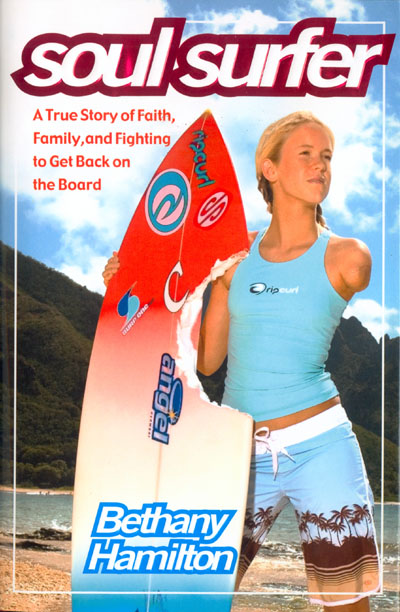
Here’s a little more related to the controversy over the temporary removal of the words “Holy Bible” from a scene in the new film, Soul Surfer.

On Patheos.com, Frederick Schmidt discusses Hollywood’s Digitally Enhanced Religion.

My interest is in the implied notion of those films: the notion that spiritual and religious commitments can be generic and yet formative—the notion that the best faith is an undefined faith and a God without a name.

It is this notion that is both misleading and largely errant. A faith without content might sell a lot of movie tickets. It might generate a warm feeling or two. On a rare occasion an unnamed God can even get us started on a spiritual journey. The Apostle Paul knew that and so do those whose first steps on their journey are taken with a Twelve Step Program. But an unnamed God does not have much staying power.

Why? Because to name God is to name what God wants and with it the purpose of life, the nature of our values, and the shape of our commitments. The decision to name God is a decision to name what is real and, by definition, what is unreal—what is important and what is less important, or even trivial. Naming God, in other words, is itself an act of commitment.

…The gutted, empty model that Hollywood offers has all the attraction of that foamy white stuff in a bag that passes for bread in the grocery store.

Making Short Films for Multi-Lingual Audiences

How do we create a variety of compelling narrative stories while eliminating one of the primary channels of communication, spoken dialogue and narration?

I’m just starting to work with a group in Europe on some short film projects. I was asked to help them hone their skills in making narrative short films. Their goal is to create short films that will stimulate spiritual conversations. Their challenge is that they want their films to be distributed very easily across many countries and language groups. Ideally, they’d tell stories without the use of dialogue that would need to be dubbed or subtitled.

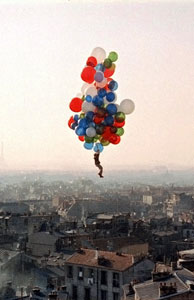
The Red Balloon

So, without resorting to pantomime (a mainstay of youth evangelism in Europe), how do we create a variety of compelling narrative stories while eliminating one of the primary channels of communication, spoken dialogue and narration?

If you do an internet search for “non-verbal film” you will come up with only a few standard reference points, usually films like Koyaanisqatsi, a well-known non-verbal film that is really a sort of visual tone poem, very impressionistic, but very powerful and influential. That film, and others like it, tend to be intentionally, un-structured in terms of story. They intend to be evocative rather than directive in their message.

For our purposes, we would like to be evocative, to be sure, but we also want to tell a story that is understandable. As I’m searching my memory for examples, I’ve come up with The Red Balloon, a film from my childhood that is very well-known. As far as I remember, there is no real dialogue in that film (not that no one speaks at all) and the story is very clear and has deep emotional range. Another film that I’ve thought of is called, The Snowman. You can usually catch it on television during the holidays. Again, it has a strong storyline but no dialogue. Both of these films are classics for many reasons, including their musical scores and, in the case of The Snowman, the amazing animation style.

So I’m thinking through principles that can help us develop some films that are easily understood across a range of language and cultural groups and that do more than present a funny situation or clever visual twist and little else. Most short films I’ve found that have little or no dialogue tend to be this type: jokes, clever situations, or visual experiments that have little story.

I’m working on my principles. I’d be interested to hear what others think, and if you know if examples of films I should watch.

Why We Need Poetry

…this is an official thank-you to my friends and those I will never meet, who are poets.

It is difficult
to get the news from poems
yet men die miserably every day
for lack
of what is found there.

– From Asphodel, that Greeny Flower by William Carlos Williams

This quote came from an invitation to subscribe to a poetry magazine. Guess I’m on the right list; it helps me to nurture the image I have of myself as a deep, thoughtful, avant-garde sort of person. And I really do like good poetry.

Poetry seems to me to be even less practical than most other fine arts. If you’re a painter, you can at least do portraits for rich people or, worst case, make a living as a corporate graphic designer while you wait for the world to appreciate your real passion. Dancers can get reality tv shows or teach little girls at the rec center. We filmmakers can hope to work on commercial projects that at least have a semblance of creativity – or else infomercials if we’re desperate – while our indie art film dukes it out for audiences at film festivals in mid-America.

Poets? I guess they have the greeting card industry.

So this is an official thank-you to my friends and those I will never meet, who are poets. I’m trying to teach my kids to love poetry, even if they can’t make a living at it.

Muslim, Christian Artists Journeying Together

The Arts can serve as one of the most effective mediums to build bridges of respect, understanding, sharing and friendship between East and West, Muslims and Christians.

What if we really listened to each others’ stories, saw things through others’ eyes; would it make a difference in the world?

Here’s an encouraging arts festival, beginning Feb 3 in Cairo. I wish I could be there!

Caravan 

Encouraging East and West, Muslims and Christians, to journey together through the Arts

The Arts can serve as one of the most effective mediums to build bridges of respect, understanding, sharing and friendship between East and West, Muslims and Christians. Therefore, Caravan was started by Paul-Gordon Chandler as an informal catalyst to explore and encourage the interplay between Faith and the Arts—and more specifically within the context of interfaith, encouraging Muslims and Christians to journey together through the Arts…thereby seeing the Arts used to facilitate intercultural and inter-religious dialogue.

Check out the web site: Caravan Festival of the Arts

Fingerprints of God in ‘Secular’ Film – Article

Can we find the fingerprints of God in the stories of our culture?

There is a great book by Don Richardson called “Eternity In Their Hearts” that talks about the ways every culture has remnants of God’s truth remaining from creation. The book approaches the subject from a point-of-view of cross-cultural missions, but I find that it helps me to think about how my own multi-faceted culture also bears the fingerprints of God in its stories, even if God is rejected on the surface.

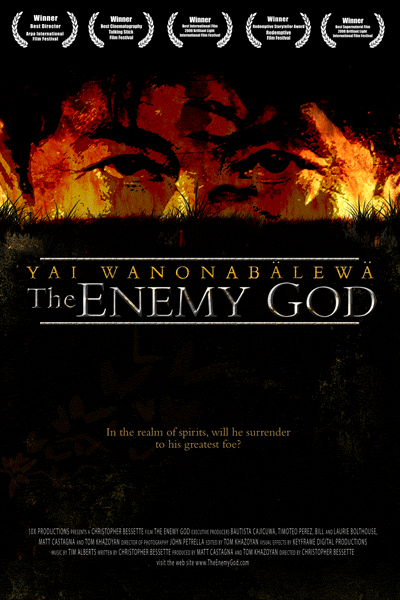
TEG PosterOur film, The Enemy God, tells the story of the Yanomamö people in the Amazon and  how there were seeds of truth about God present in their own traditional stories. However, these truths were twisted until they became a curse to the people.

Rather than merely react and shun the creative work of our culture, is it possible to use the stories and myths and passions that we find in Hollywood and independent films to point people to Christ? The article below by Garrett Brown encourages us to look into popular film to see the points of connection, the ways ‘Common Grace’ may be found, as a means to build understanding and relationship. These conversations, in relationship, may be the beginning of a journey to faith, even if the starting point of the story is despair. Perhaps, especially when the story begins with despair?

Article: Temple of the Unknown God

What ways do you see bridges to conversations about God in the popular culture around you, in the lives of your neighbors and friends?

Nollywood – There is no life without Stories

In this TED presentation, a filmmaker looks at the key to healthy society … a thriving community of storytellers

Zambia-born filmmaker Franco Sacchi discusses Nollywood, Nigeria’s booming film industry (the world’s 3rd largest) in a TED talk in Arusha, Tanzania. He created a documentary that follows a number of Nigerian filmmakers and highlights the unique voice that filmmakers have found in this developing country. His insights into the role and power of visual storytelling are intriguing to me.

“Try to imagine a world where the only goal is food and a shelter, but no stories – no stories around a campfire…It’s meaningless… I think that the key to healthy society is a thriving community of storytellers. And I think that the Nigerian filmmakers really have proved this.

Storytelling is a commodity, a staple; there is no life without stories”

Sacchi says the key to a healthy culture is the storyteller. What are we doing to bring stories to our people? What kinds of stories are we telling – stories of despair, complicity, and oppression, or justice, hope, and freedom?