Micro-budget filmmaking is all about embracing limitation and making the most of it.
How often do we either complain about lack of resources, or else never actually make anything because we’re waiting for the funds to come in? This article on Filmmaker Magazine’s blog throws down the gauntlet; just make your film; make films that make sense; you don’t have to make bad films!
The value of art lies in execution, not materials, thus, a small budget does not necessarily mean a bad film. The elements that make a film great have little to do with budget, e.g., narrative craft, camera placement, and acting. I know what you’re thinking: to place the camera a certain way, or hire a talented actor costs money — it has everything to do with budget. Sorry, I disagree. Micro-budget filmmaking is all about embracing limitation and making the most of it. Don’t have a crane or dolly? Look at the way Yasujiro Ozu utilized a static camera in virtually all his films. All you have is Uncle Bob as your lead? Look at the way John Cassavetes used non-actors. The greatest common factor of all successful micro-budget films is their potent use of available resources. Give David Lynch a cheap camera and a tiny house, and he is sure to come up with something amazing.
Mourned by his Yanomamö friends, Joe Dawson passed away on Thursday night in Coshilowateli, Venezuela.
Joe Dawson passed away on Thursday night in Coshilowateli, Venezuela. He and his wife, Millie, have lived among the Yanomamö since 1953, giving their lives to learn from, love, and serve their adopted indigenous community. Through Joe and Millie and their 10 children, the Yanomamö in the Amazonas region came to understand that the Great Spirit that they feared as their Enemy, Yai Wanonabalewa, was really their Creator who loves them. For those who accepted this news, it meant the end of a life of constant fear and bloodshed that was driven by the spirits they possessed. Many Yanomamö today are mourning the loss of their true brother, Pepiwa (Joe’s Yanomamö nickname), but are thankful for his life.
Here’s a short documentary video featuring Joe and Millie, telling their story of how God first called them to go serve the Yanomamö. It’s part of a series that gives a background to the feature film, Yai Wanonabalewa: The Enemy God. That film tells the story of the how the Yanomamö discovered the truth about the spirits and the one Great Spirit who brought them peace.
You can find more information about The Enemy God film on DVD, including more documentary segments that tell Joe and Millie’s story on the film’s web site: www.TheEnemyGod.com
…no matter what the resources, budget, etc. we always push ’til there’s nothing left — and then complain about the limitations.
When there are no boundaries, the possibilities may seem too large. That’s why some of the greatest art and innovation has come from a situation of constraint.
My experience has been that, no matter what the resources, budget, etc. we always push ’til there’s nothing left — and then complain about the limitations. And I know I can do this whether I’ve got a million dollars or nothing at all.
Here’s a great article about what I’d call the blessings of constraints. I say that because I know that I do my best work when I am challenged. Actually, I’m spending my days now looking for those sorts of challenges – projects that are ‘impossible’ and with huge constraints from the start. Anyone up for a Turkish action-adventure film, a Maasai Opera, or a sitcom for refugees in South Asia?
My interest is in the implied notion of those films: the notion that spiritual and religious commitments can be generic and yet formative—the notion that the best faith is an undefined faith and a God without a name.
It is this notion that is both misleading and largely errant. A faith without content might sell a lot of movie tickets. It might generate a warm feeling or two. On a rare occasion an unnamed God can even get us started on a spiritual journey. The Apostle Paul knew that and so do those whose first steps on their journey are taken with a Twelve Step Program. But an unnamed God does not have much staying power.
How do we create a variety of compelling narrative stories while eliminating one of the primary channels of communication, spoken dialogue and narration?
I’m just starting to work with a group in Europe on some short film projects. I was asked to help them hone their skills in making narrative short films. Their goal is to create short films that will stimulate spiritual conversations. Their challenge is that they want their films to be distributed very easily across many countries and language groups. Ideally, they’d tell stories without the use of dialogue that would need to be dubbed or subtitled.
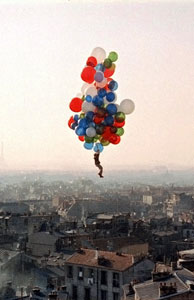
The Red Balloon
So, without resorting to pantomime (a mainstay of youth evangelism in Europe), how do we create a variety of compelling narrative stories while eliminating one of the primary channels of communication, spoken dialogue and narration?
If you do an internet search for “non-verbal film” you will come up with only a few standard reference points, usually films like Koyaanisqatsi, a well-known non-verbal film that is really a sort of visual tone poem, very impressionistic, but very powerful and influential. That film, and others like it, tend to be intentionally, un-structured in terms of story. They intend to be evocative rather than directive in their message.
For our purposes, we would like to be evocative, to be sure, but we also want to tell a story that is understandable. As I’m searching my memory for examples, I’ve come up with The Red Balloon, a film from my childhood that is very well-known. As far as I remember, there is no real dialogue in that film (not that no one speaks at all) and the story is very clear and has deep emotional range. Another film that I’ve thought of is called, The Snowman. You can usually catch it on television during the holidays. Again, it has a strong storyline but no dialogue. Both of these films are classics for many reasons, including their musical scores and, in the case of The Snowman, the amazing animation style.
So I’m thinking through principles that can help us develop some films that are easily understood across a range of language and cultural groups and that do more than present a funny situation or clever visual twist and little else. Most short films I’ve found that have little or no dialogue tend to be this type: jokes, clever situations, or visual experiments that have little story.
I’m working on my principles. I’d be interested to hear what others think, and if you know if examples of films I should watch.


 MindSoulStory