Worthwhile Reading – “The Writer’s Journey”

Christopher Vogler combines Joseph Campbell and Carl Jung to paint a picture of mythic structure in storytelling for film.

I’m reading “The Writer’s Journey”- one of the prominent screenwriting texts. In it, Christopher Vogler combines Joseph Campbell and Carl Jung (with Syd Field and Robert McKee looking on) to paint a picture of mythic structure in storytelling for film. It’s all Heroes and Archetypes and elixirs. If you want to understand popular film story structure, it’s an important read.

If I have any hesitation, it’s that Vogler presents an important point-of-view for film structure, but he often rhapsodizes about these mythic truths and ‘energies’ in a way that makes me feel like I’m in a new age self-help seminar. At least he’s enthusiastic!

Collaboration, Not Charity

I want to learn to give people something to get excited about, to honor their gifts in the best way I’m able, and to help them to feel that they are making a significant contribution with their time and talents.

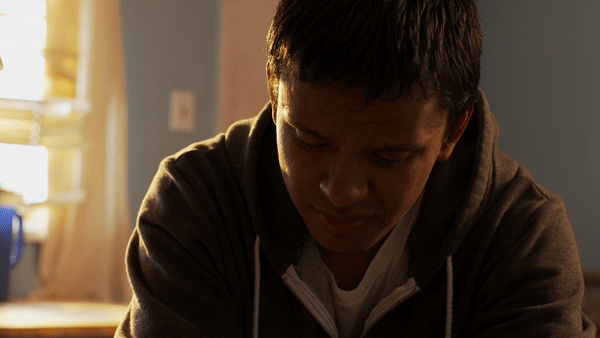
Jacob faces a difficult choice.

I sometimes act like I prefer to be a sort of lone-ranger. I’ve been a filmmaker for almost 30 years and have worked professionally in a variety of production roles.

But really, that’s not what I want. What I really enjoy is the heat of real collaboration with really talented and dedicated teammates. I can get a good deal of the way to a great product with the things I know. But to really make something great, I need help. I want help. I want to work with others who are into excellence, have great attitudes, and are generous with themselves.

Michael wakes up after a beating, in Jacob's home.

This past weekend I experienced a two great production days on my film, Street Language. I’m the writer and director, and we’re making it for no budget as a mentoring project and as a film to serve inner-city organizations that work with the homeless and at-risk teens. Because we’re making it with no financial resources other than what I can scrape together from my (less-than-explosive) IndieGoGo campaign (Be A Part Of It!) I have worried about how to gather a crew, locations, cast, and all of the other things that go into making a film the right way. (I must be too old to be making films like I’m a starving college student, but that’s kind of what we’re doing, but professionally!)

I have been blessed with a great team, from Chloe Anderson, my Co-Producer, to my DP, Gaffer, on down to my high-school student PAs. They are all volunteers, but they don’t act like it’s we’re a charity case. I have been on many professional sets where people are making real money and I have to say that they don’t run any better than ours. We are working long days in practical locations and everyone acts like it’s their project! You can’t ask for more than that.

I want to continue, even after all these years, to give people something to get excited about, to honor their gifts in the best way I’m able, and to help them to feel that they are making a significant contribution with their time and talents.

Filming again this weekend. Here’s praying for more of the same.

Write Beyond The Screen

With our film, Street Language, I’ve been learning to take advantage of the opportunities that the web and other technologies present to extend the storytelling beyond the confines of the short film I’ve written.

When you write a screenplay you are creating a world in your mind that is rich and complex, full of both familiar and extraordinary characters, places, and action. But, as a screenwriter you must be incredibly disciplined to filter all of that complexity and richness down to the essential pieces that are needed to tell your story in within the brief, linear, constraints of the film medium. This is especially challenging with short films.

With our film, Street Language, I’ve been learning to take advantage of the opportunities that the web and other technologies present to extend the storytelling beyond the confines of the short film I’ve written. In a nutshell, I’m giving my audience new ways to learn about characters, follow their lives outside of the film, and connect with the themes of the film in ways that can affect the real world. I want to blur the line between fiction and reality in a way that has the potential to create change in the lives of my audience and their world in positive ways.

Street Language is our first attempt at multi-channel transmedia storytelling. We’re beginning small, with a few alternate channels where interested viewers can explore characters and themes of the film in more depth. For instance, we are creating social media presences for our two main characters that will give backstory and a timeline leading up to the events in the film. One character’s story arc before the film begins is quite interesting. It’s a trajectory that we can tell through common social media tools. So part of the release of the film will be creating linkages to social media channels where audiences can discover this deeper story.

Also, we can create a bridge between the fictional and real world in which our story takes place. Our film is set in an urban center, with our main character a street kid who lives alone in a ‘squat’ he has found for himself. With our non-profit partner organizations, we can connect audiences to real-world situations and people to help them further explore themes in the film. Most importantly, we want to help audiences engage in meaningful ways after they view the film. If anything, we see the film and the extended media story world as being entertaining catalysts to help viewers become part of change on behalf of the urban poor, homeless, and disenfranchised people in their communities.

Here are some bullets that capture the essence of what I’m saying:

• Multiple delivery channels give a screen writer the opportunity to communicate beyond the script and the linear, set, format of a film. These channels include social media, mobile devices, web sites, games, motion comics, etc.
• In my screenplay I often want to leave information out to help create interest, suspense, or to more deeply engage my audience’s mind. However, I can take advantage of different delivery channels to fill in gaps and fill out the world of my characters.
• If you are writing for film today I believe you must, at the very least, learn about transmedia, augmented reality, and other trends that are fully entrenched in the commercial film franchise world. In Hollywood, a screenwriter may create the script alone, but the additional story elements (mostly marketing-driven) are usually controlled by outside hired guns. In the independent film world, I think writers should create and control the story world of their characters beyond the film element. Those who write for multi-channel story delivery are truly transmedia storytellers.
• My personal goal is to learn and grow in this area so that I can continue to be the driving force in the creative story elements that accompany my films. I’m not saying that I’ll become an expert in game theory, social media storytelling, and all of the other ways we can work. I’m saying that I want to be fluent and competent enough to facilitate a team of experts from other disciplines who can collaborate to develop a full expression of our story world.
• I do believe that there will remain a place for simple, linear storytelling. We all like to be entertained and not work at it so much. However, I wonder whether that will become a smaller and smaller part of the visual storytelling world.
• This does not necessarily mean movies will turn into games where the audience ‘controls’ the world. People are trying to envision and execute this sort of new form of storytelling, where the audience is fully immersed as a character in the ‘narrative.’ However, there will be a place for well-told and structured stories. What I’m talking about is expanding the storytelling space beyond the screen.

I’d be interested to hear your thoughts and experiences about expanding the storytelling space.
Non-Professional Actors?

…I am looking for that spark of un-self conscious truth in their voice, their eyes, their body-language.

I’m in the process of casting for “Street Language“, a short film project I’ve written. It’s a no/low budget project meant to serve as a mentoring experience for emerging filmmakers here in Denver. The final film will be made available to non-profits who work in urban areas with at-risk youth, the homeless, and other disenfranchised communities.

As we’ve been auditioning actors for the two lead roles I have been wrestling with my priorities. At the level we’re seeing (and paying), of course, their experience is limited. Some have had mostly school theater experience, perhaps a few student films or community theater. They are budding, but not fully blossomed yet. So I, as a Director, must look deep to see their potential.

In working with non-professional or less-experienced actors a wise friend, Christopher Bessette, told me he looks for moments of truth. We have the advantage stage directors don’t have; we can edit. An actor may not be able to carry a continuous scene with complete truthfulness and realism. However, we can see the truthfulness of a performance in a certain look, a single line delivered without self-consciousness or ‘acting’.

When I was editing our last feature, The Enemy God, I spent much of my time matching performances over several takes between actors who had never acted before – they were indigenous Kekchi Maya people from the jungle. In the end I heard comments in screenings of the film about how great the acting was. If you looked at raw takes, you would be discouraged. Indeed, some of our crew members commented that we weren’t getting anything worth using. One of those same crew members, our DP, was floored when he saw the finished film. “That wasn’t what I saw!” He was convinced because, in the editing process, we found the moments of truth in a rough performance by novice actors. I don’t recommend merely saying “We’ll fix it in post.” but sometimes there is truth to that phrase.

When I’m casting, I am looking for that spark of un-self conscious truth in their voice, their eyes, their body-language. If I see that, I can have more confidence that I can draw out a performance that will bring out a truthful story from an actor who is giving us their passion and commitment but may not have the acting experience.

Security

Following Jesus will mean surrendering the power that masquerades as security in order to love the neighbor and welcome the stranger.

I read this quote this morning and it really connected with a short film I am preparing to shoot in July. The story concerns Jacob, a young man who lives an unseen life in the midst of the crowded city. When he stumbles upon a businessman, bleeding in an alley, he must decide whether he can take the risk to help.

Whether we live in the inner city or the suburbs, we must constantly ask for the strength to extend ourselves for others. It goes against our natural inclinations. As Scott Bader-Saye says,

“Following Jesus will mean surrendering the power that masquerades as security in order to love the neighbor and welcome the stranger. It will mean avoiding the safe path in order to pursue the good. But in a culture of fear, we find such risks all the more difficult since our natural inclinations lead us to close in on ourselves when we face danger. How can we maintain the posture of the open hand toward a world that scares us?”

You Are Solving The Wrong Problem | UX Magazine

“Find a faster way to fail, recover, and try again.” Good words.

 It’s easy for me to get bogged-down with a big vision. Sometimes I respond to a great task or challenge with inaction. Maybe I can’t see the solution up-front, or perhaps I’m afraid to fail. Other times, I respond with a flurry of activity, creating a whole process and environment in which to solve the problem–but never arriving at a solution. This article talks about how important it is for us to clearly see the true problem, not the most obvious one.

It talks about Paul McCready, the inventor of the first successful human-powered airplanes, and his brilliant insight into the real problem to be solved; it wasn’t how to get a human in the air. 

There is some problem you are trying to solve. In your life, at work, in a design. You are probably solving the wrong problem.Paul MacCready, considered to be one of the best mechanical engineers of the 20th century, said it best: “The problem is we don’t understand the problem.”

Article here: You Are Solving The Wrong Problem | UX Magazine.

His bottom-line:

When you are solving a difficult problem re-ask the problem so that your solution helps you learn faster. Find a faster way to fail, recover, and try again. If the problem you are trying to solve involves creating a magnum opus, you are solving the wrong problem.

I was talking with my son recently about a college paper he needed to write. I knew that what he needed was to see the real problem, not the problem that had him stuck. He is hesitant to start down a wrong path. He wants to have it all together in advance so he doesn’t fail or waste his time. I encourage him to just get after it, write, outline, brainstorm. Encounter the hurdles, but do it aggressively, quickly. Sometimes the temptation is to finesse every sentence before moving on. That’s a killer.

The most successful projects I’ve done (and delivered on-time) are ones where I was not paralyzed by setting up the perfect system first or knowing that I was on the perfect trajectory from the beginning. I go after it, encounter failure of some sort, re-group and re-orient. That gets me there. I try (imperfectly) to apply this to my script writing, visual editing, presentations, and classes I teach. I am just as prone as my son to become paralyzed, to over analyze, and to never get started– even on something that means a lot to me.

“Find a faster way to fail, recover, and try again.”  Good words.