Today = Three meetings, three films, three cultures: urban US, Africa, Eurasia.
Category: Storying
Spiritual Stories for Skeptics
 Within a Christian worldview, supernatural events are accepted and even expected. We pray for things like that– we call them miracles–to help solve our problems. We believe they are possible, perhaps even common. However, to people who perceive the world from a purely naturalistic, materialistic worldview, ‘miracles’ are absurd. It is naive to look for them or to observe events and assign that label to them.
So how do you bridge this gap? It is the bane of Christian “message movies.” I mean, how is it possible to tell a story that is compelling, maybe even convincing, when there is no overlap in worldview? If the story is dependent on a supernatural event, a miracle, to drive the change in the Protagonist or defeat the Antagonist, how can one prevent a person who doesn’t share the belief that such an event is possible from tuning out. They will just dismiss the story as fantasy drivel.
 I’m working on a story right now that poses such a dilemma. It is a true story of how a traditional indigenous culture has been transformed, positively, through a spiritual change brought about through acceptance of the teachings of Jesus in the Bible. It’s a minefield because we are dealing with very strong emotions and viewpoints about culture and what’s appropriate to do and talk about. It is anathema to talk about someone changing their traditional beliefs to follow teachings that come from outside their culture. [Of course, it’s absurd to consider any culture ‘pure’ and static and perfect – as if any culture has not ever adapted a new idea from outside that proved attractive or beneficial to adopt.]
What I am trying to navigate is the reality experienced by the indigenous people themselves. It is their story, not mine. They say very plainly that the ‘new ways’ are better than their old ones and that many of the changes have come through supernatural events. They see the very real, practical effects on their lives every day. They make no apologies for changing. They also don’t consider themselves to be ‘traitors’ to their culture or puppets of outsiders, as some might claim. They merely say, “We heard these ideas and decided that they are true and help us in positive ways.” How can you argue with that? Isn’t that what human rights are all about: self-determination? But it doesn’t work that way. Outsiders are constantly deciding what others may embrace and what ways they may change.
 We dealt with this directly with our film, Yai Wanonabälewä: The Enemy God (website here). I received hate-mail and the scorn of many who claimed to represent the interests of the Yanomamö, whose story we told (at their request.) How dare we attempt to tell a spiritual story of an indigenous group? How dare the Yanomamö themselves give up their traditional beliefs and practices to embrace a ‘white-man’s religion’? Of course, if you actually talk with the Yanomamö with whom we partnered, they will tell you that these new ways are merely the truth that had been twisted and hidden in their own traditional ways. They say they are still fully Yanomamö. And, of equal importance, they believe that the new ways of following Jesus are the only way they can survive as a people. “The old ways were causing our people to die out.” says Bautista Cajicuwa, a Yanomamö headman and the first shaman to give up his traditional spirits.
Finding Common Ground
What we tried to do in the script for The Enemy God, and what I’m attempting now in this new story, set in Africa, is to establish common ground with my audience. I want to begin a conversation and present a story that has elements that are compelling for everyone, not just people of a particular faith. I’m thinking about the things we can agree on first – like the dreams of my characters that are more universal: peace, a hope for the future, freedom from oppression, etc. From this common ground I can begin to weave a story that includes themes and topics on which all audiences may not agree – like spiritual points-of-view and values. My goal is to create a story conversation with my audience that, while not necessarily ‘winning’ an argument with everyone, presents a compelling, honest, and respectful apologetic. They may be uncomfortable with the choices made by my characters, especially the ones who choose to follow new ways rather than their traditions, but they will need to at least grudgingly accept that the choies are real and meaningful for those that have made them.
By placing my story arguments on more common ground and by making the story less about the areas where there is no consensus, I have a chance to win a hearing. I will avoid deus ex machina moments so common in films with a spiritual agenda (most popular Christian films, it seems). The point is not to depend on acceptance of a miraculous event to explain everything. The point is to tell the story of the change, including spiritual elements, in a way that makes the spiritual a natural part but not the only focus. Can we agree that the new reality for these characters–their change over the course of the story–is a worthy goal? If a specific spiritual change is indelibly linked to the outward change, might it be worthy of consideration too? That’s a question worth asking and a conversation worth having.
Classical Music As An Immersive Experience
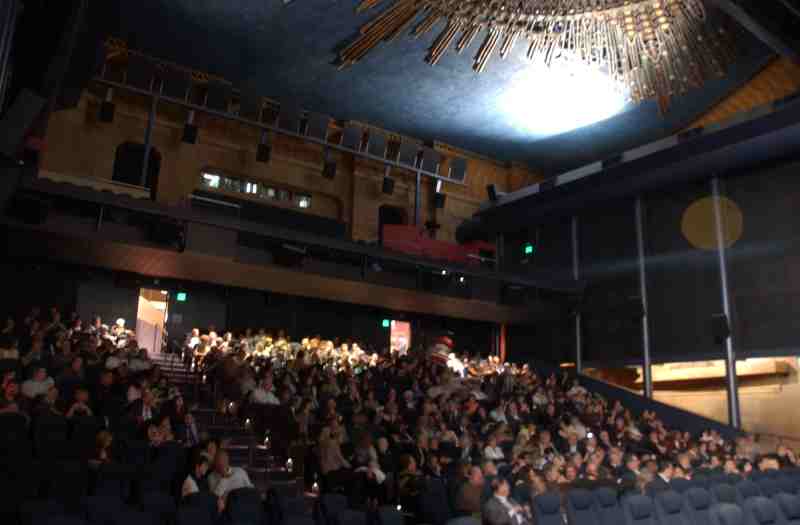
Valor Symphonics wants to break down the invisible wall between the performers and audience, creating an immersive experience that goes beyond passively listening to the music.
 There is a new youth orchestra in town. My daughter is a growing young musician, so we checked out an informational meeting. I was blown away by the vision they have for Valor Symphonics here in the South Metro Denver area. Their goal is nothing less than redefining what it means to bring classical music to the community. They want to break down the invisible wall between the performers and audience, creating an immersive experience that goes beyond passively listening to the music. Here’s how they describe some of what they envision.
Classical orchestral music is at the core of what we do, yet we recognize that classical music is struggling to maintain momentum in our culture. We are about regaining that momentum. We plan to passionately and creatively infuse classical music with contemporary sound, story, media, staging and lighting, aspiring to redefine the classical experience in an interactive way people will love!
In my previous life as a media producer in Southern California, I was involved in youth conference events where we tried crazy things to make the event interactive with 10,000 teenagers. That was before computers could do much live, but we were all about making the event a participatory experience with a bit of a story. So I was excited to talk with the folks who are developing Valor Symphonics; they are not just music people, but include dance and film and technology creatives who are all looking at how to reignite the experience of music for concertgoers. I can’t wait to see where this goes (especially, of course, if my daughter gets a chair. Here’s hoping.)
You Are Solving The Wrong Problem | UX Magazine
“Find a faster way to fail, recover, and try again.” Good words.
It’s easy for me to get bogged-down with a big vision. Sometimes I respond to a great task or challenge with inaction. Maybe I can’t see the solution up-front, or perhaps I’m afraid to fail. Other times, I respond with a flurry of activity, creating a whole process and environment in which to solve the problem–but never arriving at a solution. This article talks about how important it is for us to clearly see the true problem, not the most obvious one.
It talks about Paul McCready, the inventor of the first successful human-powered airplanes, and his brilliant insight into the real problem to be solved; it wasn’t how to get a human in the air.
There is some problem you are trying to solve. In your life, at work, in a design. You are probably solving the wrong problem.Paul MacCready, considered to be one of the best mechanical engineers of the 20th century, said it best: “The problem is we don’t understand the problem.”
Article here: You Are Solving The Wrong Problem | UX Magazine.
His bottom-line:
When you are solving a difficult problem re-ask the problem so that your solution helps you learn faster. Find a faster way to fail, recover, and try again. If the problem you are trying to solve involves creating a magnum opus, you are solving the wrong problem.
I was talking with my son recently about a college paper he needed to write. I knew that what he needed was to see the real problem, not the problem that had him stuck. He is hesitant to start down a wrong path. He wants to have it all together in advance so he doesn’t fail or waste his time. I encourage him to just get after it, write, outline, brainstorm. Encounter the hurdles, but do it aggressively, quickly. Sometimes the temptation is to finesse every sentence before moving on. That’s a killer.
The most successful projects I’ve done (and delivered on-time) are ones where I was not paralyzed by setting up the perfect system first or knowing that I was on the perfect trajectory from the beginning. I go after it, encounter failure of some sort, re-group and re-orient. That gets me there. I try (imperfectly) to apply this to my script writing, visual editing, presentations, and classes I teach. I am just as prone as my son to become paralyzed, to over analyze, and to never get started– even on something that means a lot to me.
“Find a faster way to fail, recover, and try again.” Good words.
be a learner | theMissonBook.com
Why is this such an innovative concept? Why do we even have to mention this as the preferred approach to cross-cultural ministry?
“Be A Learner”
Why is this such an innovative concept? Why do we even have to mention this as the preferred approach to cross-cultural ministry? Perhaps it’s because we westerners have a low view of other cultures, of alternative learning and communicating styles, of worldviews not formed by the western “Enlightenment?”
Even when I’m teaching something, I always realize my need to learn and understand my students and their context first. I’ve made enough mistakes with my assumptions and biases.
Many times churches ask what they can do on the mission field. How can they help? They often ask this assuming the answer will be that they should come to teach, show, model and develop the people they are trying to help.
- We come in as teachers.
- We come in as health care workers.
- We come as scientists.
- We come in as business leaders.
- And to be honest, sometimes we come across as “know-it-alls.”
What if, instead, we came in as learners?
Read Larry McCrary’s full post here: be a learner | theMissonBook.com.
Visual Story Summit – Edinburgh
If I had one sense to convey from today it is that we are all hungry and eager for partnership.
I think a key to becoming more effective and growing in my chosen field is getting together with like-minded people who place a high priority on sharing and partnership.
I’m in Edinburgh, Scotland this week for a Summit hosted by the Visual Story Network.
The event hasn’t yet begun–that’ll happen in the morning–but in the midst of a meal together, prayer time for the event, and hanging out after-hours, I have already had really significant conversations with people I’ve not met before. These aren’t just exchanges of friendly banter; they are real expressions of excitement for what God is doing through very different organizations all over the world. And they are realizations of ways that we can and should work together and share resources.
If I had one sense to convey from today it is that we are all hungry and eager for partnership. The words ‘collaboration’, ‘generosity’, and ‘sharing’ are sprinkled in every conversation I hear.
 MindSoulStory