Open Your Eyes To Other Cultures This Christmas

In the holiday season, it’s easy to become focused on ourselves and our own small worlds. If you’re looking for an eye-opening view of another of God’s diverse cultures, you owe it to yourself to watch this video clip and check out “The Enemy God” on DVD.

In the holiday season, it’s easy to become focused on ourselves and our own small worlds. If you’re looking for an eye-opening view of another of God’s diverse cultures, you owe it to yourself to watch this video clip and check out “The Enemy God” on DVD.

THE MICROBUDGET CONVERSATION: SCRIPT V. STORY | The Filmmaker Magazine Blog

As we’ve been in the process of making a ‘micro-budget’ short film, I have been thinking about the viability of such ventures.

As we’ve been in the process of making a ‘micro-budget’ short film, I have been thinking about the viability of such ventures. I know it’s possible to work like we have been working – with volunteer cast and crew and donated locations and gear. And I believe our film, structured, scripted, planned, and all that, will benefit from the approach.

This article, published a while back on Filmmaker Magazine’s blog, makes the argument that micro-budget filmmakers should embrace an alternative approach that emphasizes the discovery of stories that flow from real life, rather than struggling to come up with the perfect screenplay.

 … if our goal as micro-budget filmmakers is to make films free of budget restrictions, we need to find alternative methods that embrace the places we live, allow us to believe they are interesting, and trust the people around us to bring us some really interesting material. We all know this familiar adage: life is stranger than fiction. Once we let life leak into our narratives, I think we will be shocked at the abundance we suddenly have with the stories that are available.

THE MICROBUDGET CONVERSATION: SCRIPT V. STORY | The Filmmaker Magazine Blog.

I have a lot of experience in documentary filmmaking so I can appreciate the freedom and excitement of seeing stories unfold in the process of making a film. And I can see the author’s point that taking this approach can get filmmakers away from the computer and into the real process of making something. There is a part of me that does sometimes want to just pick up a camera and see what happens.

Award-Winning Film – DVD sale

Support independent cross-cultural filmmaking in this holiday season!

TEG Poster[Shameless self-promotion follows! Thanks for your indulgence.]

I don’t really want to engage in the modern spirit of commerce for the upcoming holiday season. However, if you or a loved-one is:

  • – a movie buff
  • – fan of other cultures
  • – rainforest fanatic
  • – into spiritual warfare issues
  • – looking for a unique film experience…

We’ve got a great movie deal for you.

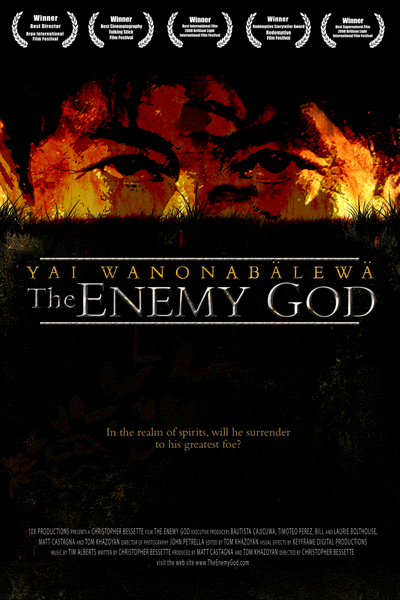
Our multi-award-winning feature film, Yai Wanonabälewä: The Enemy God, is now on sale the film’s web store. We even have bundle specials with books related to the film.

Support independent cross-cultural filmmaking in this holiday season!

How Do You Know When It’s Done?

I think this is a common malady among indie filmmakers. I know I will see something on every viewing that strikes me as odd, something that needs a little smoothing, a lingering doubt about a creative choice I’ve made.
Ah, that feeling when you make the last edit, tweak the last audio level, hit ‘render’ on your video file…

I love that moment when I know I have finished my film. It’s something I’m eager to show to the world. There’s nothing left hanging. It’s the last time I fire up the project in my editing program.

Actually, it’s hard for me to see that moment clearly. As a filmmaker who has his hands in the minutia of my films, that moment is actually really blurry. I may not even see it until it’s history. In the case of “Street Language” my new short, I’m the guy who wrote the script, did much of the production management, directed the film, and have been completing the post-production after a friend did the rough cut for me. Some pieces are really put to bed: script, acting, the picture cut, even the music at this point. But, because I’m a slightly obsessed filmmaker–I call it ‘high standards’–and because I have the whole film sitting on my own hard drives that I can fire up anytime a thought strikes me, this film seems to be inching slowly toward being really “done”.

I think this is a common malady among indie filmmakers. I know I will see something on every viewing that strikes me as odd, something that needs a little smoothing, a lingering doubt about a creative choice I’ve made. I know I’ve been over the film to the sub-frame level in many parts. Some choices are ones I’ve examined many times and come to the same conclusion. And I know that there are no perfect films–to the filmmaker. Look at George Lucas, causing a ruckus because he’s still tweaking Star Wars, after over 30 years!

If George does it, maybe I shouldn’t feel guilty. I know other filmmakers who walk away and don’t look back; and sometimes I think they should have.

I am really happy with this film. Preview audiences have loved it. My wife cried at the right time when I showed it to her (and doesn’t think I’ve wasted my time and our money making it.)

I know I’ll walk away and be done with it, soon. I’ve finished hundreds of projects in my career. But when you’re in this stage, just after all of the really heavy lifting is done, but before it’s set loose on the world, there is a little season of hesitation, button pushing, and oh-so-close satisfaction.
Screenwriters Slogans For The Wall

42 ways to improve your screenplay – from Chris Jones blog

From screenwriter and instructor Alexander MacKendrick – a great set of 42 aphorisms he had on his walls as he wrote and taught screenwriting. Good writing is not about learning everyone’s rules and ‘can’t miss’ methods. But learning from those who have gone before is part of task.

Read the complete list at: ChrisJonesBlog.com- Screenwriters Slogans For The Wall… by Alexander MacKendrick.

A few of my favorites that I haven’t read in every screenwriting book:

Self pity in a character does not evoke sympathy.

Coincidence may mean exposition is in the wrong place, i.e. if you establish the too-convenient circumstances before they become dramatically necessary, then we feel no sense of coincidence. Use coincidence to get characters into trouble, not out of trouble.

Ambiguity does not mean lack of clarity. Ambiguity may be intriguing when it consists of alternative meanings, each of them clear.

The role of the ANTAGONIST may have more to do with the structure of the plot than the character of the PROTAGONIST. When you are stuck for a third act, think through your situations from the point of view of whichever characters OPPOSE the protagonist’s will.

If you’ve got a Beginning, but you don’t yet have an end, then you’re mistaken. You don’t have the right Beginning.

DRAMA IS EXPECTATION MINGLED WITH UNCERTAINTY.