One of the Most Unique (and Engaging) Movies Ever Made

I felt as if I was living inside the body of a Yanomamo tribesman. Honest — this movie is stirring.

It’s always nice to hear endorsements of your work from people you really respect. Doug Lucas is is very involved in cutting-edge training and information related to seeing the gospel transform every culture. He publishes a weekly e-mail update with news of all kinds at Brigada.org. Here’s a review of our film, The Enemy God, that Doug wrote recently.

“Yai Wanonabalewa (The Enemy God)” has to be one of the most unique movies ever produced… and it’s now been released on DVD.

Hear me well: This is an intense film… It is sometimes graphic, sometimes heart-wrenching, but always engaging. My advice for professors of seminary classes looking for something related to spiritual warfare, anthropology, world religions, and Cross-cultural communications: Run, don’t walk, to order a copy. To anyone working in folk religions, you finally have an inside view to what goes on “inside their heads.”

I can’t even put into words the “point of view” from which the story is told… because it seems to be totally Yanomamo… cross-cultural. I felt as if I was living inside the body of a Yanomamo tribesman. I spent much of my time fearing what might come next. Honest — this movie is stirring. If you have a missionary working among tribal peoples, this will give you a new perspective on prayer and its potential to make a difference. Don’t expect a heart-warming, feel-good story like something from a Disney kids’ film. Expect to be sobered. Expect to experience a perspective you’ve never felt before.

Read the whole article from Brigada.org here: One of the Most Unique (and Engaging) Movies Ever Made.
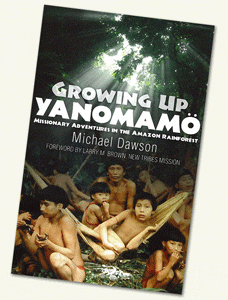
Book Of The Year: Growing Up Yanomamö

…was recently voted “Book of the Year, Biographies” by the Christian Small Publishers Association.

Growing Up Yanomamö
Growing Up Yanomamö

I was excited to hear that a friend’s book, Growing Up Yanomamö, was recently voted “Book of the Year, Biographies” by the Christian Small Publishers Association.

“… a bit of Huck Finn, with an Amazon twist.” says Simon Romero, Andean Bureau Chief, “The New York Times”

It’s a fun read, about Mike Dawson’s years growing up in the jungle as the child of missionary parents. He also reveals some very personal trials and his experiences of how God’s faithfulness is demonstrated in every circumstance.

You can buy the book here on our web site. Look for the special pricing on the book bundled with The Enemy God DVD.

Mike also happens to be one our our Executive Producers on The Enemy God film. He brought continuity between our indigenous partners and our filmmaking team that was essential to making a truly authentic film.

“THE SCENE MUST BE DRAMATIC”

It takes an immense amount of discipline to resist spoon-feeding your audience. And it takes the same discipline to solve story problems by writing only dramatic scenes, not expositional scenes.

I read a post that talks about this topic this week on Go Into The Story, one of my current favorite blogs. Scott Myers collects an amazing variety of great screenwriting tips, scene analysis from famous films, and general wisdom from great screenwriters.

In this post, Scott re-posts a letter from David Mamet (if you don’t know him, you should find his stuff) that was written to his writing team for a television series Mamet was writing a few years ago. In the letter (there is some colorful language – it’s Mamet) he exhorts his writing team to be disciplined to write scenes and dialogue that serve to move the story forward dramatically.

It’s the bane of every writer to have to deal with collaborators (not the word Mamet uses to describe the network executives) who make suggestions. Often the suggestions (or orders) come in form of a request to make the story more clear, fill in blanks, flesh out characters, etc. And, too often, this results in dreaded exposition speeches by characters or the inane dialogue that spells out what the audience probably already knows and would enjoy discovering for themselves. Mamet colorfully outlines his criteria for what needs to happen in a scene for it to be worthy to remain in a script.

Go Into The Story: “THE SCENE MUST BE DRAMATIC”.

Mormons and Film

Mormonism has arguably been the most cinematically engaged religious movement in the history of motion pictures. The Church of Jesus Christ of Latter-day Saints and its members have been involved with filmmaking since the medium’s beginning. The first motion picture to feature Latter-day Saints was the Spanish-American War actuality Salt Lake City Company of Rocky Mountain

I find this a fascinating article from an insider’s perspective. It gives a historical and cultural overview of the use and influence of motion pictures within the LDS world. It would be interesting to me to understand the dynamics and how they are the same and how they differ from mainstream Evangelical Christian filmmaking.

Click here to read the full article on Patheos: Mormons and Film.

Film Essentials: Rube Goldberg Machines

I have to say I have a weakness for what are commonly known as “Rube Goldberg” machines. The name refers to an American comic artist who created crazy contraptions to do ordinary things. Here is the official Rube Goldberg web site, if you’re really interested.

Of course, there is the wildly popular music video (8 million + views on YouTube as of this month) by OK Go, “This Too Shall Pass” which is based entirely on a Rube Goldberg machine that provides the visual thread for the song. I like the way it gets bigger and more out of control as the song progresses. And it must be fun to destroy pianos, TVs, etc. It lost some of the purity of the machine as it got more crazy; you lost some of the actual mechanical connection and they could have faked lots of it if they wanted to. This is just one recent example.

I also loved the Honda Accord commercial from 2003. While not as wild as the OK Go video, it has a more pristine, controlled, elegant feel to me. When I saw it for the first time, I was blown away. Wikipedia has a complete description of the commercial, its production, and impact for Honda. 606 takes over 4 days to complete; that’s insanity.

There’s a cool parody of the Honda spot, just for fun.

The Newtons' Workshop DVD

The ones I’ve seen tend to be in commercials or music videos, but what about such machines in narrative films. I cant remember one off-hand. I wrote a Rube Goldberg machine into a script I did back in 1996 or so. It was for an educational video series I wrote and directed for Moody Video called, The Newtons’ Workshop. The main character was an eccentric inventor or sorts, with a passion to teach his grandkids about science. My production designer had a fun time constructing a mail delivery system for Grandpa’s house. We were not skilled, well financed, or patient to make it all work perfectly in real life, so we used creative edits to make Grandpa’s machine work on film. I don’t have a clip, but I’ll post it sometime when I can get it digitized.

Anatomy of a Scene: Mother – Interactive Feature

Watch a short clip from a film with the Director’s commentary. In this case, South Korean filmmaker Bong Joon-Ho’s “Mother”. I love these NYTimes interactive features. I think they really take advantage of the potential for electronic publishing, especially for cool things like film analysis.

Click here to watch and listen: Anatomy of a Scene: Mother – Interactive Feature – NYTimes.com.

Of course, this is a film that almost nobody has seen, but I like the way the director tells the story and builds the tension in creative ways with interesting camera angles and pacing. What do you think?