We’ll see what AFM brings but we refuse to be at its mercy.
We’ll see what AFM brings but we refuse to be at its mercy.
The past year has been mostly depressing with reports of poor attendance and low purchases at the various film markets all over the world. It seems like it wasn’t a good time for us to finish our film, The Enemy God, and to be trying to fight it out amongst all of the content looking for distribution.
You can read some folks’ theories about how this year might be different in this article about the American Film Market which opens today in Santa Monica, CA.
There are whole worlds where we feel we just can’t learn enough, don’t know enough of the players, and we’d basically get eaten alive – like at AFM. So our sales agent, Entertainment 7, is our big hope out there to sell foreign rights, television, VOD, etc. We received good news from the last market in Cannes; we found a distributor for South Asia and Scandinavia. (I blogged about that here.) That gives us confidence that there are still distributors looking for remarkable content that falls outside the mainstream rom-coms, thrillers, and big action pictures.
The rule now is to avoid just sitting back and waiting for those glorious license deals to fall in your lap! We have seen how our film plays for audiences, once we reach them, and we’re in this for the long haul. We are working the hybrid-distribution world as well; call it partial-DIY. Our screenings at the Starz FilmCenter last month proved we could get audiences in theaters via word-of-mouth. We have a new DVD out to press right now and we’ll pump that one via social media; so we aren’t just sitting back at the mercy of the markets.
I’m pretty good at working off intrinsic motivation. It certainly helps when there are not a lot of people patting you on the back for an extended period of
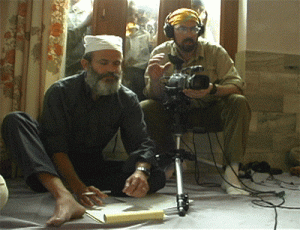
Me (r) filming interviews in the Punjab, about nine years ago!
time! But, it is hard to be patient, even when you have a good sense that you’re on the right track and that God is going to bring it on in his time.
Today we got a nice pat on the back related to our film, The Enemy God. I got a call from a company that just picked up the rights to the film for India, Singapore, Korea, and Malaysia. Additionally, they will distribute it in Sweden, Denmark, Norway, and Finland. (Odd combination, I thought.) This is the first news of an official ‘sale’ by our sales agent who has the worldwide rights to the film. Their job is to make these deals for us so the film can get out to places we don’t know how to reach ourselves. We keep busy with our own DVD distribution in our niche markets, but overseas deals are really out of our hands.
The problem for us has been the long wait. Independent film deals usually take a while to develop. There is lots of competition. Our film is not a highly commercial property. But we do know there’s an audience for it, if we can connect with the right distributors who understand and appreciate the film – and who have an audience in mind. This deal came about because the company heard about our film from friends in the UK (don’t know who, exactly) and then the distributor e-mailed me. I passed it on to our sales agent and forgot about it. At least, I didn’t think much would come of it. Now, I get the call and I’m talking with a very encouraging, enthusiastic, visionary man who loves our film, wants to build web sites, do Hindi and other language translations, and all that. [And, he asked about our next projects too – which are kind of sketchy right now…]
I don’t know how big this company’s reach is in India and the other countries or how big the audience will be. I don’t know if we’ll see a dime of revenue from this deal. But we’ll leave all of that in God’s hands too. This is a film that never could have been made – according to some wise people. So we’re content to see God do miracles, see deals like this come up, and we’ll live a while longer off that encouragement from God and a few people.
Want to hear our war-stories? Click on the entries under “Pages>Articles” in the sidebar just to the right to read about our experiences in film production.
A friend suggested that I share a bit about my experiences in rolling out a feature-length dramatic film on the independent film festival circuit. I have just returned from a screening of The Enemy God at the Arpa International Film Festival.
A friend suggested that I share a bit about my experiences in rolling out a feature-length dramatic film on the independent film festival circuit. I have just returned from a screening of The Enemy God at the Arpa International Film Festival. The festival was held at the Egyptian Theater in Hollywood, a landmark location. While this is definitely not a major festival, I think it is pretty typical of most of the thousands of smaller festivals in which really-independent, un-connected, filmmakers will find themselves. And I think there are some good lessons that we have learned since our film has been on the circuit.
Arpa Int'l Film Festival Poster
Very briefly, our film is a dramatic, feature-length film that is set in the Amazon rainforest. It tells the true story of a Yanomamö Indian shaman and the supernatural struggles for the survival of his people. It stars a cast of indigenous actors and is filmed in the K’ekchi’ language. From that description, it is probably apparent that our does not have “blockbuster” written all over it. However, we believed when we began the project and have discovered that there is an enthusiastic audience for the film, when we can get people to see it.
Here are a couple of observations I’d like to throw out to you from our festival experiences:
1. Speak truthfully, and you can speak to people who may not normally be eager to listen to you.
Our film deals with spirituality and indigenous culture. The point of view presented is definitely one that embraces the positive change that has occurred among the Yanomamö who have embraced a Christian worldview. This means that they gave up many of their former beliefs and traditions. We expect lots of backlash from secular audiences because the idea of a person from a traditional culture giving up some of that culture is not politically correct. However, our commitment to the Yanomamö (who came to us with the idea for a film) was that we would help them speak with their voice rather than come in and tell their story from the perspective of outsiders. This made for a very difficult film, but in the end we have been welcomed in to festivals that are decidedly not Christian. Ten of twelve festivals that we have been a part of are ‘secular’ or ‘spiritual’ in a more broad way. We have received many nominations and a number of awards at these festivals. At a festival that was entirely about Native American/Indigenous filmmaking, our film was invited and celebrated by an audience whose normal view of white Christians is one of resentment and distrust because of past wrongs. But because they trusted us and believed that we were sincere in our storytelling we were able to enter their world and gain a hearing. We also made the effort to listen well and to honor their stories.
2. It is possible to create art that can live in the middle space between the secular and spiritual and have positive influence.
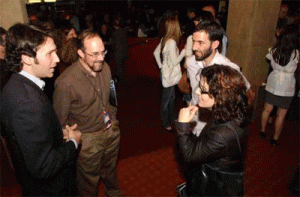
Alex K., Festival Director, and Tom Khazoyan talk with film fans at the Arpa Festival
You may feel as though you are stuck outside of both worlds. Sometimes I think that the real truth is, if you try to walk in the middle you spend your time getting attacked from the left and right. While it can seem easier to work from the extremes, there are many of us who want to wrestle in the gray areas. With our film, we began with a story that had universal themes, but a definite Christian worldview. As we wrote the script, we were committed to being entirely truthful, but also to make a film that engages the viewer’s mind and speaks with a unique voice. Only a few ‘secular’ critics have had a problem with the message of the film. Perhaps they tend to compartmentalize what they see and probably spin it the way they are comfortable. Ironically, we have had criticism from Christians who feel that our film does not give a clear gospel message. [It does not help that we have demon worship, drug use, violence, and naked women in our film!] However, most Christians have embraced the film and the challenges of it. One festival actually put us in their “distinctly gospel” category – not the one we thought best fit our film. The bottom-line for me is that we have found ourselves in the fascinating middle of cultures. That is a place some “Christian films” find hard to penetrate. I’m glad we are here.

 MindSoulStory