Why is this such an innovative concept? Why do we even have to mention this as the preferred approach to cross-cultural ministry?
“Be A Learner”
Why is this such an innovative concept? Why do we even have to mention this as the preferred approach to cross-cultural ministry? Perhaps it’s because we westerners have a low view of other cultures, of alternative learning and communicating styles, of worldviews not formed by the western “Enlightenment?”
Even when I’m teaching something, I always realize my need to learn and understand my students and their context first. I’ve made enough mistakes with my assumptions and biases.
Many times churches ask what they can do on the mission field. How can they help? They often ask this assuming the answer will be that they should come to teach, show, model and develop the people they are trying to help.
We come in as teachers.
We come in as health care workers.
We come as scientists.
We come in as business leaders.
And to be honest, sometimes we come across as “know-it-alls.”
Micro-budget filmmaking is all about embracing limitation and making the most of it.
How often do we either complain about lack of resources, or else never actually make anything because we’re waiting for the funds to come in? This article on Filmmaker Magazine’s blog throws down the gauntlet; just make your film; make films that make sense; you don’t have to make bad films!
The value of art lies in execution, not materials, thus, a small budget does not necessarily mean a bad film. The elements that make a film great have little to do with budget, e.g., narrative craft, camera placement, and acting. I know what you’re thinking: to place the camera a certain way, or hire a talented actor costs money — it has everything to do with budget. Sorry, I disagree. Micro-budget filmmaking is all about embracing limitation and making the most of it. Don’t have a crane or dolly? Look at the way Yasujiro Ozu utilized a static camera in virtually all his films. All you have is Uncle Bob as your lead? Look at the way John Cassavetes used non-actors. The greatest common factor of all successful micro-budget films is their potent use of available resources. Give David Lynch a cheap camera and a tiny house, and he is sure to come up with something amazing.
Meet Yuseff and Andrea – two people who represent billions who communicate, learn, and connect in a post-literate world.
Meet Yuseff and Andrea – two people who represent billions who communicate, learn, and connect in a post-literate world.
This is a short film, created for the Visual Story Network, that explains the urgent need for compelling visual stories to communicate the fullness of God’s love for the world. I’m a part of VSN and share this vision.
More and more, the desire grows in me simply to walk around, greet people…Still, it is not as simple as it seems…
“More and more, the desire grows in me simply to walk around, greet people, enter their homes, sit on their doorsteps, play ball, throw water, and be known as someone who wants to live with them. It is a privilege to have the time to practice this simple ministry of presence. Still, it is not as simple as it seems…”
A friend of mine, Scott Lundeen, runs a ministry called Urban Entry here in Denver. He creates media resources to help envision and equip people to engage in relationships and service among the poor and marginalized in our communities. I think they’re doing some cool stuff.
This video was just posted on his blog site. It is based on a quote from Henri Nowen and gets right to the heart of a struggle we often face. Those of us who are acculturated for performance and delivering measurable results as a way of measuring our worth do well to consider Jesus’ call to be in relationship first. It’s what Nowen refers to as a ‘ministry of presence.’ Check it out.
Do you feel the same struggle in your vocation or avocation to make a difference in peoples’ lives? Do you feel envious of programs that get media attention or that are better resourced. Do you feel pressure to ‘achieve’ in a way that ultimately takes you ‘off the streets’?
I sometimes whine about my sad lot – that it’s difficult to see how I can sustain what God has called me to do, that I feel pressure to jump on the social media train that demands I become ‘famous’ in order to become influential and effective. But I feel God’s correction when I really am with the people I want to serve: with my film students, on Skype calls with friends in Africa who teach me as much as I want to teach them, these are the moments of reality and clarity.
My prayer for you is that you have many of those moments, even in the midst of the “necessary” things that shadow the life-giving things.
…no matter what the resources, budget, etc. we always push ’til there’s nothing left — and then complain about the limitations.
When there are no boundaries, the possibilities may seem too large. That’s why some of the greatest art and innovation has come from a situation of constraint.
My experience has been that, no matter what the resources, budget, etc. we always push ’til there’s nothing left — and then complain about the limitations. And I know I can do this whether I’ve got a million dollars or nothing at all.
Here’s a great article about what I’d call the blessings of constraints. I say that because I know that I do my best work when I am challenged. Actually, I’m spending my days now looking for those sorts of challenges – projects that are ‘impossible’ and with huge constraints from the start. Anyone up for a Turkish action-adventure film, a Maasai Opera, or a sitcom for refugees in South Asia?
How do we create a variety of compelling narrative stories while eliminating one of the primary channels of communication, spoken dialogue and narration?
I’m just starting to work with a group in Europe on some short film projects. I was asked to help them hone their skills in making narrative short films. Their goal is to create short films that will stimulate spiritual conversations. Their challenge is that they want their films to be distributed very easily across many countries and language groups. Ideally, they’d tell stories without the use of dialogue that would need to be dubbed or subtitled.
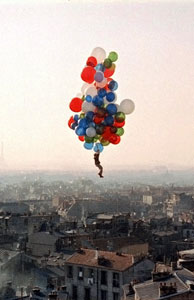
The Red Balloon
So, without resorting to pantomime (a mainstay of youth evangelism in Europe), how do we create a variety of compelling narrative stories while eliminating one of the primary channels of communication, spoken dialogue and narration?
If you do an internet search for “non-verbal film” you will come up with only a few standard reference points, usually films like Koyaanisqatsi, a well-known non-verbal film that is really a sort of visual tone poem, very impressionistic, but very powerful and influential. That film, and others like it, tend to be intentionally, un-structured in terms of story. They intend to be evocative rather than directive in their message.
For our purposes, we would like to be evocative, to be sure, but we also want to tell a story that is understandable. As I’m searching my memory for examples, I’ve come up with The Red Balloon, a film from my childhood that is very well-known. As far as I remember, there is no real dialogue in that film (not that no one speaks at all) and the story is very clear and has deep emotional range. Another film that I’ve thought of is called, The Snowman. You can usually catch it on television during the holidays. Again, it has a strong storyline but no dialogue. Both of these films are classics for many reasons, including their musical scores and, in the case of The Snowman, the amazing animation style.
So I’m thinking through principles that can help us develop some films that are easily understood across a range of language and cultural groups and that do more than present a funny situation or clever visual twist and little else. Most short films I’ve found that have little or no dialogue tend to be this type: jokes, clever situations, or visual experiments that have little story.
I’m working on my principles. I’d be interested to hear what others think, and if you know if examples of films I should watch.


 MindSoulStory