One of the Most Unique (and Engaging) Movies Ever Made

I felt as if I was living inside the body of a Yanomamo tribesman. Honest — this movie is stirring.

It’s always nice to hear endorsements of your work from people you really respect. Doug Lucas is is very involved in cutting-edge training and information related to seeing the gospel transform every culture. He publishes a weekly e-mail update with news of all kinds at Brigada.org. Here’s a review of our film, The Enemy God, that Doug wrote recently.

“Yai Wanonabalewa (The Enemy God)” has to be one of the most unique movies ever produced… and it’s now been released on DVD.

Hear me well: This is an intense film… It is sometimes graphic, sometimes heart-wrenching, but always engaging. My advice for professors of seminary classes looking for something related to spiritual warfare, anthropology, world religions, and Cross-cultural communications: Run, don’t walk, to order a copy. To anyone working in folk religions, you finally have an inside view to what goes on “inside their heads.”

I can’t even put into words the “point of view” from which the story is told… because it seems to be totally Yanomamo… cross-cultural. I felt as if I was living inside the body of a Yanomamo tribesman. I spent much of my time fearing what might come next. Honest — this movie is stirring. If you have a missionary working among tribal peoples, this will give you a new perspective on prayer and its potential to make a difference. Don’t expect a heart-warming, feel-good story like something from a Disney kids’ film. Expect to be sobered. Expect to experience a perspective you’ve never felt before.

Read the whole article from Brigada.org here: One of the Most Unique (and Engaging) Movies Ever Made.
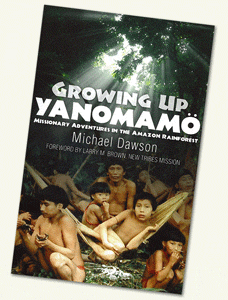
Book Of The Year: Growing Up Yanomamö

…was recently voted “Book of the Year, Biographies” by the Christian Small Publishers Association.

Growing Up Yanomamö
Growing Up Yanomamö

I was excited to hear that a friend’s book, Growing Up Yanomamö, was recently voted “Book of the Year, Biographies” by the Christian Small Publishers Association.

“… a bit of Huck Finn, with an Amazon twist.” says Simon Romero, Andean Bureau Chief, “The New York Times”

It’s a fun read, about Mike Dawson’s years growing up in the jungle as the child of missionary parents. He also reveals some very personal trials and his experiences of how God’s faithfulness is demonstrated in every circumstance.

You can buy the book here on our web site. Look for the special pricing on the book bundled with The Enemy God DVD.

Mike also happens to be one our our Executive Producers on The Enemy God film. He brought continuity between our indigenous partners and our filmmaking team that was essential to making a truly authentic film.

What Is the Source of Creativity?

This is a great TED presentation by Elizabeth Gilbert, author of the bestselling book, “Eat, Pray, Love”.

As she considered the daunting task of continuing her writing career in the wake of a smash hit, she began to wonder about our cultural expectations and assumptions about creativity. More importantly, she began to ask about the source of that creativity. Her conclusion is that what our culture decided post-Enlightenment is that creative genius must come solely from within human beings. This idea has also led to the stereotype of the tortured artist, living on the edge of an often self-destructive lifestyle.

Ms. Gilbert rejects that idea as an ideal or something we should settle-for. She argues for reclaiming more of a classical idea of creativity coming from alongside and from outside of a human creator. While she doesn’t come at this conclusion from a Biblical worldview, I really resonate with what she says because I know the True Source of creativity.

“THE SCENE MUST BE DRAMATIC”

It takes an immense amount of discipline to resist spoon-feeding your audience. And it takes the same discipline to solve story problems by writing only dramatic scenes, not expositional scenes.

I read a post that talks about this topic this week on Go Into The Story, one of my current favorite blogs. Scott Myers collects an amazing variety of great screenwriting tips, scene analysis from famous films, and general wisdom from great screenwriters.

In this post, Scott re-posts a letter from David Mamet (if you don’t know him, you should find his stuff) that was written to his writing team for a television series Mamet was writing a few years ago. In the letter (there is some colorful language – it’s Mamet) he exhorts his writing team to be disciplined to write scenes and dialogue that serve to move the story forward dramatically.

It’s the bane of every writer to have to deal with collaborators (not the word Mamet uses to describe the network executives) who make suggestions. Often the suggestions (or orders) come in form of a request to make the story more clear, fill in blanks, flesh out characters, etc. And, too often, this results in dreaded exposition speeches by characters or the inane dialogue that spells out what the audience probably already knows and would enjoy discovering for themselves. Mamet colorfully outlines his criteria for what needs to happen in a scene for it to be worthy to remain in a script.

Go Into The Story: “THE SCENE MUST BE DRAMATIC”.

How Can Games Speak To Us?

I believe that visual storytelling is about entertainment, but not merely entertainment when it reaches its highest level. I want to tells stories that open audiences’ eyes and hearts.

In my on-going ponderings about visual storytelling, I really believe that I’ll be working on video games in the future – even though I’m a filmmaker by trade.

My son is a budding game developer and we have discussions all the time about the place of storytelling in games. I challenge him to think in terms that are beyond the current state-of-the-art. What could be done in terms of meaning and cultural influence in a game? I have a friend in the major game world who says the development studios are looking to Hollywood for screenwriters who can help them amp up the characters and story arcs of their games. If you read reviews of games like Mass Effect 2, you know that there is a real effort being made in some games to create more depth and nuance beyond a few cut scenes that move a player through to the next battle.

Mass Effect 2

However, when I think story and when my son talks about story in games, there is still a wide difference. Mass Effect 2, for instance, uses a dialogue wheel to give a sense of choice and independence to conversations, but you don’t mistake the game for anything written by Robert Towne.

When will we get there?

Chris Remo talks about it in this article.

If you’re reading this, you probably love games. I certainly do, but I’ve been thinking about what makes games important to me, versus what makes books or music or film important to me.

… there are still some parts of my life that games don’t address that well. They do the “fun” thing well, and they give me a lot to think about, but they rarely speak to me the same way a wonderful novel, film, or album does.

…the reason I bring this up is because I think games are certainly capable of more. I think games have the possibility of speaking to us as people, not just as gamers, in the same way a film by Scorsese or Bergman or Welles or Kurosawa or the Coen brothers can speak to us as people, not just as film buffs; in the same way The Beatles or Beethoven or Charles Mingus or the Flaming Lips or John Adams speak to us as people, not just as analysts of music theory; in the same way Vonnegut or Nabokov or Shakespeare or Orwell or Hammett speak to us as people, not just as appreciators of literary prowess.

[Read the entire post from IdleThumbs]

I believe that visual storytelling is about entertainment, but not merely entertainment when it reaches its highest level. I want to make films, and perhaps games, that open audiences’ eyes and hearts. When the master storyteller, Jesus, explained why he told stories he said, “…to nudge people toward receptive insight.” When I think about the potential of games, with open worlds and personal participation in the story, I am excited to see what’s possible.