Great post from Ted Hope; inspiration to indie filmmakers everywhere. It may exhaust you to read this list, but read it anyway. Filmmaking is not for the half-interested or half-committed.
Christopher Vogler combines Joseph Campbell and Carl Jung to paint a picture of mythic structure in storytelling for film.
I’m reading “The Writer’s Journey”- one of the prominent screenwriting texts. In it, Christopher Vogler combines Joseph Campbell and Carl Jung (with Syd Field and Robert McKee looking on) to paint a picture of mythic structure in storytelling for film. It’s all Heroes and Archetypes and elixirs. If you want to understand popular film story structure, it’s an important read.
If I have any hesitation, it’s that Vogler presents an important point-of-view for film structure, but he often rhapsodizes about these mythic truths and ‘energies’ in a way that makes me feel like I’m in a new age self-help seminar. At least he’s enthusiastic!
As a Producer, you will certainly need to adapt to many different communication methods in order to make your project come off smoothly.
Directing music videos in Africa
Just a quick tip for Producers and those who dream of that lofty position. Don’t assume communication is received, just because you sent it! In the real world of crew members, actors, and businesses, people hear things in different ways. As a Producer, you will certainly need to adapt to many different styles in order to make your project come off smoothly.
For instance, you may be in the habit of communicating almost exclusively via text messages, e-mail, or phone calls. Most people emphasize one of these as their primary mode of communication. On my production team, however, I have to learn how my collaborators prefer to communicate – AND, which methods I can count on to really have them HEAR the message I’m sending.
My rule is; if the conversation is not two-way then you have not communicated. It need not be simultaneous, like in a phone call or face-to-face conversation. But you cannot say you’ve communicated until you hear back from the person. It’s like leaving a phone message; if they don’t respond, it doesn’t count. You can’t say, “I talked with them.”
Never assume what you mean to say has been heard until you get that feedback. And you must learn how different collaborators on your team like to communicate. It’s something I’m constantly working on and learning.
If you don’t like this, try animation and work alone in your basement. 😉
There are some situations that you can just solve with money; sometimes money doesn’t talk!
I’m in the midst of a creative film production with an all-volunteer cast and crew, a mix of seasoned professionals and students, and locations that are being provided gratis by a variety of business and property owners. [This isn’t all that unusual, but I’m a long way from film school and sometimes wonder whether I should have developed a ‘real’ career by now!]
Our Alley Location - beautiful!
Late last week one of our key locations for “Street Language” fell through. Actually, it became apparent that, for all of our conversations and attempts to ‘lock’ a skid-row motel room for a long day of filming, the manager had decided we weren’t worth the hassle. No way to reserve a room, no guarantee one would be empty, no control whatsoever – so we bailed. There are some situations that you can just solve with money; pay more for the room, rent for a week, etc. Sometimes even money doesn’t talk.
Of course, I was praying hard this weekend!
We are partnering with a great organization Mile High Ministries, who is hot on the project and wants to help. So we got back on the phone to them. They run a transitional housing facility for homeless families called Joshua Station. Yesterday, just before our final production team meeting, we got word that they have a room available for us. Someone just moved out, so it could be a mess. Perfect!
We are really fortunate to have a great crew of volunteers for this project and they are doing their best to keep their commitments to our shooting schedule. It’s a lot to ask of these people who all have other jobs, families, and lives outside of our project. So we are very grateful.
We go into production this coming weekend (Aug 20/21). You can help us make it happen by joining our production team through our IndieGoGo page.
I continue to hammer into my students’ minds the idea that the story is the most important thing, even in a visual/technological artform like cinema.
I continue to hammer into my students’ minds the idea that the story is the most important thing, even in a visual/technological artform like cinema. I have always appreciated Barbara Nicolosi’s thoughts about screenwriting (didn’t know she was Catholic.)
In a very real sense, we need stories to teach us how to live. We enjoy the lessons because stories delight us with their artistry.
We are all about making films that work on multiple levels. They need to be great stories and great cinema, but we can also make them work beyond entertainment.
We are all about making films that work on multiple levels. They need to be great stories and great cinema, but we can also make them work beyond entertainment.
Our upcoming short film project, Street Language, is an example of what we’d like to do more of in the Denver area. The production is a collaboration between professional filmmakers, students, and volunteer crew members PLUS local organizations that work in our urban area with at-risk youth, the homeless, and marginalized people in our community.
The point is to make a film through a process that provides mentoring for emerging filmmakers and also serves the needs of non-profits through its story and end uses that go beyond festivals and normal distribution.
We are pleased to be working with actors from the Colorado film community like Luciano Munoz and JT Richardson. My Co-Producer, Chloe Anderson (Epicenter Pictures) is a young(er) filmmaker with whom I’ve worked over the years. My production company, 10X Productions, has done a lot of production out of the country, but we are eager to do more closer to home.
We begin principal photography on the weekend of August 20th – very soon! If you would like to connect with us, help us spread the word, or would like to be involved in this or future projects, let me know.

 We are all about making films that work on multiple levels. They need to be great stories and great cinema, but we can also make them work beyond entertainment.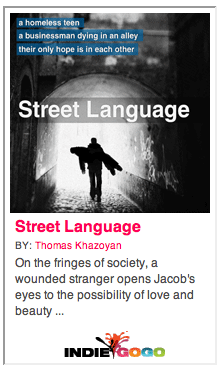
 MindSoulStory