With our film, Street Language, I’ve been learning to take advantage of the opportunities that the web and other technologies present to extend the storytelling beyond the confines of the short film I’ve written.
When you write a screenplay you are creating a world in your mind that is rich and complex, full of both familiar and extraordinary characters, places, and action. But, as a screenwriter you must be incredibly disciplined to filter all of that complexity and richness down to the essential pieces that are needed to tell your story in within the brief, linear, constraints of the film medium. This is especially challenging with short films.
With our film, Street Language, I’ve been learning to take advantage of the opportunities that the web and other technologies present to extend the storytelling beyond the confines of the short film I’ve written. In a nutshell, I’m giving my audience new ways to learn about characters, follow their lives outside of the film, and connect with the themes of the film in ways that can affect the real world. I want to blur the line between fiction and reality in a way that has the potential to create change in the lives of my audience and their world in positive ways.
Street Language is our first attempt at multi-channel transmedia storytelling. We’re beginning small, with a few alternate channels where interested viewers can explore characters and themes of the film in more depth. For instance, we are creating social media presences for our two main characters that will give backstory and a timeline leading up to the events in the film. One character’s story arc before the film begins is quite interesting. It’s a trajectory that we can tell through common social media tools. So part of the release of the film will be creating linkages to social media channels where audiences can discover this deeper story.
Also, we can create a bridge between the fictional and real world in which our story takes place. Our film is set in an urban center, with our main character a street kid who lives alone in a ‘squat’ he has found for himself. With our non-profit partner organizations, we can connect audiences to real-world situations and people to help them further explore themes in the film. Most importantly, we want to help audiences engage in meaningful ways after they view the film. If anything, we see the film and the extended media story world as being entertaining catalysts to help viewers become part of change on behalf of the urban poor, homeless, and disenfranchised people in their communities.
Here are some bullets that capture the essence of what I’m saying:
• Multiple delivery channels give a screen writer the opportunity to communicate beyond the script and the linear, set, format of a film. These channels include social media, mobile devices, web sites, games, motion comics, etc.
• In my screenplay I often want to leave information out to help create interest, suspense, or to more deeply engage my audience’s mind. However, I can take advantage of different delivery channels to fill in gaps and fill out the world of my characters.
• If you are writing for film today I believe you must, at the very least, learn about transmedia, augmented reality, and other trends that are fully entrenched in the commercial film franchise world. In Hollywood, a screenwriter may create the script alone, but the additional story elements (mostly marketing-driven) are usually controlled by outside hired guns. In the independent film world, I think writers should create and control the story world of their characters beyond the film element. Those who write for multi-channel story delivery are truly transmedia storytellers.
• My personal goal is to learn and grow in this area so that I can continue to be the driving force in the creative story elements that accompany my films. I’m not saying that I’ll become an expert in game theory, social media storytelling, and all of the other ways we can work. I’m saying that I want to be fluent and competent enough to facilitate a team of experts from other disciplines who can collaborate to develop a full expression of our story world.
• I do believe that there will remain a place for simple, linear storytelling. We all like to be entertained and not work at it so much. However, I wonder whether that will become a smaller and smaller part of the visual storytelling world.
• This does not necessarily mean movies will turn into games where the audience ‘controls’ the world. People are trying to envision and execute this sort of new form of storytelling, where the audience is fully immersed as a character in the ‘narrative.’ However, there will be a place for well-told and structured stories. What I’m talking about is expanding the storytelling space beyond the screen.
I’d be interested to hear your thoughts and experiences about expanding the storytelling space.

 We are all about making films that work on multiple levels. They need to be great stories and great cinema, but we can also make them work beyond entertainment.
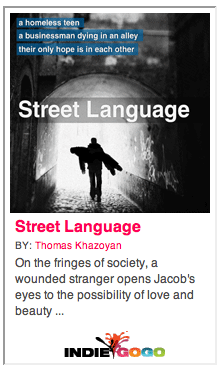 Here’s our IndieGoGo page, if you want to help us make it happen: http://www.indiegogo.com/streetlanguage

 MindSoulStory